




Home > historical houses of africa > Bab zuweila
Bab Zuweila, Cairo
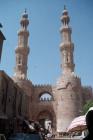
In Cairo Bab Zuweila is a medieval gate, which is still standing. It is famous in history because in the Mongol era the heads of six messengers of Hulagu (the Mongol leader) were hanged on it as a response of the Egyptian Sultan to Hulagu's threats of attacking Egypt. |
|
Before 1087, Cairo was not really
much of a fortified city with its sun dried brick
walls, though this weakness had demonstrated itself
on occasions. The city had outgrown these old walls,
and along with the attempts by the Turkoman Atsiz
to take Cairo, among other threats from the east,
clearly there was a need for additional fortification.
That year, Badr ad-Din el-Gamali, an Armenian and
the visor of El-Mustansir, employed three Armenian
Christian monks from Edessa in eastern Turkey to build
the three main gateways of the Fatimid wall made of
stone which was to provide fortification. This explains
their Byzantine-Syrian style These massive gates are
called the Bab (gate) el-Futuh, Bab an-Nasr and Bab
Zuwayla. They are each protected by flanking towers.
These gates remain some of the grandest and oldest
monuments in Cairo. This work marks the beginning
of a newly cultivated taste for stone in Cairo.
Though the city quickly moved beyond this gate Bab Zuwayla, sometimes called al-Mitwalli after El Kutb al-Mitwalli by some local inhabitants, defines the southern limits of the Fatimid City. It is named after the al-Zawila, a Berber tribe whose Fatimid soldiers were quartered nearby. Bab al-Mitwalli is a name dating to Ottoman times since the wali of the janissaries or commander of the police force charged with maintaining public order, had his residence and headquarters near here. However, that same name is also that of a Islamic saint named Mitwalli al-Butb, who had lived by the gate and worked miracles. The gate became a venue for those in need of the saint's intercession. His spirit is supposed to live behind the west side of it, where he is said to sometimes flash a light to let one know he is there.
The two minarets that helix from the towers belong to the Mosque of al-Mu'ayyad, which is located just inside the gate. They were placed atop the gate some 400 years after it was built, and make it seem far mightier than the Northern Gates. These minarets sit on semi-circular towers that are solid stone for two thirds of their height. The inner flanks of the towers near the entrance are decorated with lobed arches. These arches had been used earlier in North African architecture, and must have been introduced by craftsmen accompanying the Fatimids conquest of Egypt. This type of arch is often seen in later Fatimid and Mamluk architecture.
The towers flank a recessed, highly articulated gateway and are joined above the gateway by a curtain wall.
To support the dome over the entrance passage of Bab Zuwayla, some Spherical, triangle pendentives are used. Inside the vestibule to the right, coming from the south, there is a half domed recess with two exquisitely carved arches at the corners. They have a tri-lobed curve and the upper part is treated like a shell. The left-hand side was modified when Sultan al-Mu'ayyad built his mosque.
At the apex of the panels the arabesque medallions on the towers and the medallion on the keystone of the vault of the loggia above its great archway are representative of Fatimid techniques. Looking at Bab Zuwayla from within the city, one sees a gabled roof between the two towers that clearly show the Byzantine origins of the gate architecture. Indeed, most features of the walls and gates are completely foreign to Islamic art, aside from some Quranic inscriptions.
Perhaps has a somewhat richer tradition. But Bab Zuwayla is very similar in design to the other gates.
Regarding the gate with Mitwalli al-Qutb, until the early part of the 20th century, the gate was hung with rotting teeth, filthy rags, and all sorts of monstrous tokens of sickness and disease because of the tradition.
If any one had a headache, it would go away if one drove a nail into Zuweila, the reflection for that was the huge wooden gates were therefore defaced with thousands of nails. If anyone had a toothache, one simply need is to pull it and hang it on Zuweyla and the pain would disappear.
The sultans used to watch the start of the mahmal procession from the platform extending between the two towers on the inside in the early Mamluk period. This was the annual caravan who took the new kiswa, or cloth covering fro the Ka'ba, which was woven in Egypt, to Mecca. This platform was also used by the ceremonial drummers who played there every evening and who signaled the arrival into the city of amirs who commanded forty or more Mamluks. Having some sort of ceremonial orchestra at the city gates was an old oriental tradition. The gate was also the venue of dancers and snake charmers.
Yet, by the early 15th century, al-Maqrizi described the place as being very unlucky. It was the site of executions, and it was here for example, that Sultan Salim the Grim hung the last of the Mamluk sultans, Tumanbey from its entryway in the 16th century (1517). Unfortunately, the rope broke twice before his neck did. When the Mongols sent emissaries to Cairo demanding its surrender, they were promptly sliced up and their heads hung on this gate. Dishonest merchants might be hung from hooks or ropes, while beheading, impalement or garroting were favored for common criminals at the gate.
The barbells high up on the western gate tower are exactly what they seem to be, leftovers from a medieval physical fitness program. The full glory of the gate is best seen from the south, but one should note the strikingly medieval passage just on the north side of the gate.
Bab Zuwayla was the subject of a careful restoration, in 2001. The western gate tower, the turret and the minarets are now open to the public, and can be visited through a door next to the mosque. Inside, relics are on display, as well as votive offerings left by local residents for Mitwalli al-Qutb. The minarets of the mosque provide a wonderful view of Islamic Cairo. East of the gate the ruins of the Fatimid city wall extend for about one hundred meters, but are concealed by modern buildings. In the opposite direction, the wall makes up one facade of the Mosque of al-Mu'ayyad.